Visits

Monday, 13 August 2012

Prime Minister Johnson?


Even before the closing ceremony had finished, there had been much talk of what shape or form the  Olympic legacy may take.  There is, without question, a renewed sense of national self-confidence and a groundswell of united pride, the like of which hasn't been seen since the Thatcher government successfully liberated the Falkland Islands in 1982.   The general election of 1983 returned the Conservatives to power so ardently that a shakey Mrs Thatcher became the Iron Lady and received a mandate for change which eventually led to the socio-economic reforms which inexorably altered the nature of the UK's economy for good. Together with Charles and Diana's Royal wedding of the previous year, Thatcher's government presided over a period of renewed national fervor and converted this into stunning electoral gains.

Cameron's leadership thus far, like Thatcher's first two years, has been marked by critical voices from within his own party.  Uncertainty over his particularly cuddly brand of Conservatism has actually grown rather than died away since the 2010 General Election.  His marriage to Clegg's Liberal Democrats was a necessary union which brought his party to power but has since served to further accentuated his liberal leanings and consequently only brought further discord within the party.  Although William and Kate's marriage and the Queen's Jubilee combine to become roughly comparable in scale to the royal wedding of 1981, it has been the Olympics rather than the intervention in Libya which has been Cameron's latter day Falklands in terms of effect on the public mood.  However, Cameron's reticence to attend events down at Eton Dorny for fear of being seen near his own school, coupled with his increasingly overshadowed attendances at other events have left the Prime Minister very much a mere passenger on board the Boris train.  While Thatcher's great rival Michael Hesseltine was thrust into the background during the Falklands, Cameron's Hesseltine, Boris Johnson, has been brought to the fore.  The blonde bombshell's already high profile has gone from strength to strength during the games.  His unscripted 'Boris moments' such as the delicious moment when he was left dangling from a zip wire in the Olympic park stand anathema to Cameron's over-polished stage-managed appearances which were splashed around anywhere near a successful British athlete.

For many, despite their shared education and socio-economic backgrounds, Boris is the more approachable figure.  His ascerbic wit, shoddy dress sense and ridiculous hair provide the kind of brand identity that Cameron could only dream of.  His gaffe-prone public appearances conspire to inspire his audiences rather than concern them.  But there's more to Boris Johnson than just his humorous appeal; it's not just his public image that people love, rather that he is a successful leader:  he has delivered.  In the public's eye he is unquestionably the Commander-in-chief of London and the London Olympics and his performance in this regard has been exemplary.  When the dust settles, Johnson's electoral 'bounce' may be so strong that not even he will be able to stop it.  He is to the London Olympics as Thatcher was to the Falklands and Cameron hasn't so much as had a look-in.

It is difficult to see what could possibly propel Cameron to such heights in the electorate's regard.  As discord over the EU, the financial crisis, swinging cuts and Cameron's inability to understand that liberals will never vote for him (and Conservatives might stop doing so) continues to grow  then the party may well look for new leadership.  Johnson's unashamed Etonianism will appeal to the small 'c' conservative core of the Party in addition to the rest of the country's new found love of the man.  In answer to the articles chief question, it may just be that whether Mr Johnson wants it or not, his inexorable rise might take him to the very top and inherit the Conservative Party leadership.  He has become Cameron's Hesseltine, the de-facto stalking horse for any leadership contest of the future. That said, he would first need to be an MP or a member of the 'other place' in order to become PM and for that, he would need a constituency that would vote for him as well as a sitting MP prepared to stand aside and force a bi-election.
Thus, Boris for PM? Maybe, one day, but not yet.  First, Cameron would need to be pushed out and a constituency seat must become available.


Sunday, 22 July 2012

Re-branding; UKIP to the next level

A year ago I met with a senior member of UKIP at his home office.  For much of my time with him, the MEP in question seemed concerned that I was a member of the tabloid press.  This concern actually bordered on paranoia.  It was clear; he felt that the press was out against UKIP and that the press was to be feared.  In the light of the News Corp scenario (which occurred after my meeting with said UKIP MEP) I can see why he was concerned.  The British Press has for years taken sides, made figures of fun out of those politicians that it dislikes and generally spun stories in both positive and negative ways in order to gain influence, sell papers or both.  

However, the British media's focus on UKIP seems to be softening.  No longer the hard lens of scrutiny aimed at poking fun, UKIP is now viewed through a wide angle which landscapes the larger political picture, and crucially mainstream parties.  This is good for UKIP; the more it is framed in the same painting as the Conservatives, Labour and the Liberals, the more legitimacy it will gain.  And legitimacy is the key to acceptance, acceptance the answer to why UKIP performs so under-whelmingly at General Elections compared to their relative success in the Euros. In short, UKIP stands ready to scoop up the disfranchised, but it also needs to go further; it needs to offer credibility, brand image and aspiration. 

So, it's clear that if UKIP are to make further electoral inroads towards mainstream domestic politics then they must step up a gear.  There are several factors which look as if inadequately addressed might scupper their recent rise.  These comprise a triumvirate of issues which are as follows: 

i)  Appalling brand image
ii) Poor media relations
iii) Decentralised party structure

All three major parties have addressed these issues long ago, and UKIP need to follow suit.  After all, if you want to beat them; become them.

Therefore, this article suggests some basic ideas for UKIP which address the concerns listed above in order.  

i) Get rid of the child-like purple and yellow colour scheme and cartoon pound font.  Whilst these colours are complementary, they also wouldn't look out of place sat in patchwork together on a child's duvet cover.  However, they are unique and do separate the party from the blue of the Conservatives and the red of Labour.  Thus, swap yellow for the gold of a genuine Pound coin and deepen the purple to a maroon made from the red and blue of the Union flag.  Isn't that what it's all about?  People have gone to their deaths to defend these colours, and therefor they are incredibly powerful and have the weight and feel of history behind them.  Adopting the prestige of patriotism is an incredibly powerful and emotive thing.  With reference to the gold, I'm not talking shiny, tacky 'bling' gold, but the deep rich gold of a 10 year old, well thumbed, good old fashioned quid.  
Further, step-up the pictoral rhetoric.  The imperial lion and the green and pleasant lands of Great Britain of old are both free to good home and are presently unused by any of the mainstreamers.  Tapping into these iconic images not only lends credence but also furthers the motion of UKIP as the party of Britain.  Further, there is a current fashion trend for 'Keep Calm and Carry On' posters.  They are everywhere, in all incarnations.  UKIP need to get hold of this ready-made brand distribution, hook in to the image in their own way.  In short, take ownership of a vacant possession.  'Keep Calm and Vote UKIP' or 'Keep Calm and Leave the EU' spring to mind.  
Finally, UKIP needs to change it's name.  There are some unsavoury if entirely unjustified brand blurring with the BNP.  This needs to end.  We are in the United Kingdom and we wouldn't be considering voting UKIP if we didn't know you were a party.  Thus,
"INDEPENDENCE" is a solid, no nonsense alternative name which maintains the positive elements of UKIP and throws of the cumbersome abbreviation.  

ii) The spotlight on Alistair Campbell and more recently Andy Coulson has shown two things.  
Firstly, that each of the major parties understand the need for strong media relations.  
Secondly, that the concept of a former tabloid editor as a 'spin doctor' is a tainted one.  But this reveals an opportunity.  As the old media platforms of television, radio and the printed press begin to fade, and the new media of Twitter, Facebook and other web-based two-way content gains greater influence, the new Coulson or Campbell ought to be a social networking specialist.  The 'Facebook election' of Obama in 2008 and the recent 'Arab Spring' has revealed that only social media has the power to rival the Murdoch/BBC two party old-media monopoly.  The internet is a powerful and influential place which is yet to be adequately leveraged by any of the domestic 'big three' parties.  Hire some recent graduates who really understand this genre, go viral, understand that ideas spread through internet social networks in the same way as contagious disease spreads through populations, and take advantage of the current reticence of the mainstreamers to marry Murdoch. 

iii) UKIP operates an almost federal party structure based loosely along the regions of the UK as seen from Brussels.  This is a good tactic at Euro Election level, but falls short for domestic purposes. A central office will permit Farage to control his almost wayward MEPS and candidates, and assist in maintaining a whip and a party line which can be more efficiently controlled and disseminated across media platforms.

At it's heart, this article believes that UKIP, or 'INDEPENDENCE' as I'd suggest it should re-brand, is knocking on the mainstream's door.  Working and Middle Class families up and down the UK are disenfranchised with the usual options and are looking for a viable alternative.  On the policy front, UKIP provide this.  Support for Grammar Schools, a withdrawal from the embattled EU, reducing the deficit, patriotism and old fashioned values help form an attractive solid core of policy which will continue to garner more and more support.  However, a poor media image and a weak brand is holding the party back from achieving the respectability, no, the desirability it needs to succeed. 

Follow me on Twitter: @HortonEddison


Wednesday, 14 March 2012

Guild elections, the Kremlin & Vegetarian Sandwiches


This piece was originally written for the Aber Courier for last week’s Election Special.  However, the Courier didn’t have the balls to publish it, so here it is in full for all to read and share:

Guild elections, the Kremlin & Vegetarian Sandwiches

The sharp-eyed reader may have noticed that last week played host to the annual Guild Election beauty contest.  Being asked to write an article on the elections for The Courier really whet my appetite; finally, a chance to get stuck into a left wing institution in general (the NUS) and to wax lyrical about all that’s wrong with our Guild specifically. In-fact it didn’t turn out that way; what started out as a cognitive explosion of passionate ideas decrying the inherent left-wing bias of the Union movement, soon turned to utter boredom, complete disillusionment and finally, an unrelenting, grinding paralysis of apathy. 

With some positions uncontested and most others fought-over by candidates promising near identical manifestoes focusing on issues lifted straight from the script of an edition of children’s TV programme Newsround, there was barely a recycled sheet of A4 paper to separate them. Indeed, if you had an hour of your life to waste last week, then you may have watched some of the campaign videos or read some of the campaign posters. If you survived the mind numbing resultant coma, you’ll have noted how incredibly formulaic and ‘samey’ they all seemed. Most listed either housing or mental health as the primary plank of their manifesto (wonder why?), reinforced by several secondary Lizo Mzimba-inspired pledges concerning the environment, fair trade coffee and the world changing notion of talking to estate agents on your behalf. The battle of mindless mundane mediocrity was on. A sort of general malaise set in. Voters turned off. Some dribbled. Probably.

Despite a decidedly unethical attempt by one candidate to defame the good character of the incumbent Guild President by leaking a non-story to the national press, none of the candidates really managed to grab any headlines. Indeed, no amount of distinctly unsustainable, unethical A4 paper plastered all over campus will ever make up for the lack of genuine excitement or buzz that an engaging election should create among the student body. This is partly because none of the candidates actually got to grips with the fact that it is not the source of our coffee but the serious lack of quality Union facilities that students really care about. To admit this, would be to confess the perpetual failure of the Guild to keep pace with the needs of the modern Aberystwyth student, a failing that those standing for re-election are at least partly culpable for. This of course is with the exception of Meakin’s excellent work attracting Starbucks to the Union. But one such initiative is not enough, and the Guild’s services will appear even less satisfying with fees set to rise to £9,000 per annum from September. Students who pay more will expect more. Indeed, far too many manifestos forwarded empty hyperbole which didn’t actually mean anything at all and served only to underline the broad feeling that there was no single candidate in any position really capable of thinking of (let alone delivering) the kind of ‘outside the box’ solutions required to drag the Guild kicking and screaming into the 21st Century. Most students care little about whether we are recycling our ethically sourced eco-friendly fair trade coffee cups or not when the facilities in which we spend our time fall so far short of even the most basic expectations. This dissonance between what the students really wanted, and what the candidates actually promised, was the true unspoken cause of such enormous voter apathy at the heart of this election. 

The Guild is in-fact distanced by a yawning chasm from the actual student body.  Distanced that is, in geographical, ideational and relational terms.  Most of us know there’re some offices at the back of the Underground somewhere, but the vast majority of students never venture past the pasties and toilets into the Kremlinesque maze of closed doors and peeling paint where the Guild’s elected officials are caged.  Instead, for many students, the only part of the Guild that we’re aware of or actually visit are the commercial enterprises; the disappointing offerings presented by the Union bars and the Union Shop when we’re up on campus for lectures or seminars. For the rest of the time, around two thirds of students live at the end of a very tiring and very tall hill; at the bottom of which is a bustling town offering shops with pricing and quality as their core values, not high minded (and high priced) principals of ethics and sustainability as might be found in the Union facilities. The town pubs, bars and clubs offer drinks at half of the price of the Union, and in an environment which is twice as appealing.  The real problem with the Guild is that it’s been losing money for years, partly due to a lack of imagination or innovation.  Consequently, there’s no money to change anything, and there’s no money because nobody goes, and nobody hoes because nothing changes.  However, something has got to change before the whole system follows the Soviet Union and grinds to a juddering financial halt.  Wat students and the Guild really need are experienced people who are not just willing but capable of working with University staff to draw-up a student-focused yet equitable, financially-sustainable plan to ensure the Guild’s long-term survival.  This probably doesn’t involve higher wages for Union staff and more vegetarian sandwich options as promised by one successful candidate.
 

Broad student apathy was a direct result of a lack of such commercially capable candidates.  No one candidate suggested that the Guild buy a bar in town (why not Yoko’s?) and generate revenue from that. Nobody suggested turning the Penglais Union into a daytime Starbucks serving a noisy ‘group study’ area in order to restore the library to silent working only and generate revenues for the Union. Not one put forward a plan to recover the Hugh Owen for the studious and generate much needed revenue for the Union for all of our benefit.  Not one manifesto suggested any real understanding of financial management or presented any economic model at all for that matter. None pointed out that only after generating real revenue could the Guild offer, and deliver any real change or improvements for and on behalf of students. After studying all of the election manifestos (yawn), it’s obvious that none of the candidates had either the vision to imagine or the experience to implement real changes on such a vast but necessary scale. 

So, having established that the manifesto pledges weren’t worth the paper that Lizo’s guiding hand wrote them on (think of all those poor trees) who were the Guild Elections actually for, or rather who do they benefit? Well, the answer is pretty obvious I’m afraid; despite the promises, it is not the student body en-masse, definitely not me and definitely not you. The successful candidates have won some CV points in the form of an impressive sounding title and as an added bonus, the Sabbatical Officers get to stay in Aber for another year, paid for by you (despite your Union losing tens of thousands of pounds each year). And this is the final point. Welcome to local politics, rule number one; it’s not about your needs, it’s about the politicians’. Next time you cast a vote, pause and question who that vote really benefits; you or the candidate? 
I’ll leave you with Jeremy Paxman: “You cannot trust a word any politician says and if you shake hands with them, you ought to count your fingers afterwards. They are not the people you would want your son or daughter to marry”.

If you like this blog, please show your support by tweeting, posting and citing as often as you can.
Also, click now to follow me on Twitter: @HortonEddison

Wednesday, 30 November 2011

Socialism not Bankers to Blame for Public Sector Cuts


Today has seen tens of thousands of Britain's vast army of 6,000,000 public sector workers out on strike. The Prime Minister's own press secretary has been forced to man the immigration desk at Heathrow Airport. Millions of school children have lost a day of education, as well as elective surgeries cancelled and disruption across the country. Annoying for the UK, certainly, but for the rest of the world these are also worrying times, with more than a few echoes of the  economic situation of the inter-war years. In this article, we debunk the myth that it is 'the bankers' to blame for the mess we're in by making an assessment of why 'developed' economies (including our own) have come to owe so much money in the first instance.


In the 1930s the near collapse of capitalism was brought about by a series of defaults in an international debt triangle which ultimately forced the great depression and a second war in Europe. Indeed, right now in 2011 a an economic pyramid scheme which is at least superficially similar to that which was at fault in the '30s can be seen at play around the US/IMF/China triumvirate. Similar pillars of cyclical debt current underpins the EU experiment. In this article, we explore how modern socialist state economics are to blame for this unholy trinity and how such economic thinking has once again brought the international system to the brink of collapse.


For many on the left, the theoritical models of JM Keynes provide the genealogy of their present-day economic policies. 
Indeed, Keynesianism became the prevalent economic theory throughout much of the middle part of the last century. It is based on the essential pre-requisite that economic growth slows when the demand for production stagnates as a result of unemployment. Keynesianism suggests that the stagnation effects of unemployment can be overcome by creating the economic circumstances under which it is possible to increase the demand for products once more. The key concept to Keynsianism is that a short-term government funded stimulus which creates direct state employment, paid for with money borrowed from the markets or other nations, re-establishes the ability for the citizenry to purchase goods and services en-masse. This thus increases the need for products - ergo manufacturing - which in-term creates employment once more in the private sector. Keynsianism was not designed as a long term status-quo and was not designed to be a permanent life support system for economies, rather a short-term economic defibrillation. Indeed, the success of Keynesian investment depends on short-termism.

'Spent too much for too long and borrowed too much to pay for it'


Consequently, Keynesianism was employed with some success throughout the middle part of the 20th Century, including assisting the revival of most major economies before, during and after WW2. Therefore, it is not difficult to see why Keynesianism has attracted fans, particularly from the left where it seems to fit nicely with the ideological requirement for high public spending on generous public services. The UK Labour party’s economic policies are understandably based heavily in an interpretation of Keynesianism. Indeed, Gordon Brown's pledge as chancellor to bring about an “end to boom and bust” echoed strongly Keynes’ aims ‘to stabilize economic output during the cycle’. 


However, there are enormous problems with the modern centre-left's faith in Keynes' economic theories, as the ongoing failure of the so-called PIGS countries show us. Over the last 30 years, the governments of Portugal, Ireland, Greece and Spain have been dominated by the centre-left. Their economic policy has, like the UK's, been driven by bastardisations of Keynesian theory, borrowing heavily in order to spend on public services (read public sector workers). All have consequently spent too much for too long and borrowed too much to pay for it. 


How then has Keynesianism failed so catastrophically in the PIGS and brought Britain and the US to the maximum of their credit limits?

The first part of the answer lays partly as discussed in the fact that Keynes only ever meant high public borrowing/spending as a short term solution, not as the basis of long term economic policy.  Indeed, what the current Labour shadow chancellor Ed Balls, and his party leader Ed Miliband, both fail to understand is that it is not that the current coalition government is ‘cutting too far, too fast’ but that the previous Labour government was spending too much for too long. Labour's current  policy is entirely bi-polar; acknowledging the need to cut the deficit at the same time as advocating high levels of spending on public services. 


The second part of the answer is absolutely the key to understanding why the left can never be trusted with the economy again. It is more nuanced, but also more important. It concerns what public borrowing is actually spent on.  
In Keynes' time, an economic stimulous would buy short-term project specific blue collar workers; navvies, factory workers and builders. In the 21st century these manual trades have largely disappeared to be replaced by police officers, community outreach workers and NHS administrators who are employed on permanent contracts with pension schemes. Jobs for life. This is a change which partly reflects the evolving nature of our increasingly service based economy, but it also allows centre-left governments to claim increased public sector 'investment'. Employing one extra police officer for example, removes one person from the jobless total, adds one person to the number of police on the street, provides a basis for 'investment' in the police force. A very tempting proposition for any democratic government. In the 21st Century this is the fundamental problem with Keynesianism, and it is one that all ‘advanced’ economies (USA, PIGS, GB etc) suffer from. Here's why:


"The difference in the nature of public funded employment is the key to the mess we’re in, and it is also the key to the way out. The difference is the question of permanence"


In the middle-part of the 20th Century, working for the government meant building Autobahns in '30s Germany, manufacturing munitions in '40s America or NHS hospitals and social housing in '50s Britain. In the 21st Century, well educated citizens used to a higher standards of living simply do not wish to be employed in menial work. Instead, increasingly voter conscious centre-left parties throughout the West have sought to apply Keynesianism to jobs more conducive to electoral success, but less fitted to Keynesian stimulous.The difference in the nature of public funded employment is the key to the mess we’re in, and it is also the key to the way out. This difference is the question of permanence. Put simply, it is possible to hire and fire blue collar workers much more flexibly; when a motorway is finished, a war won or a hospital built the dependant workers can be, and are, laid off. 


However, white collar workers are of a different nature and have different expectations. Historically, office jobs form part of a career structure which assumes a level of permanence and confers a much more secure tenure as well as other benefits such as generous pensions and access to union and or legal representation which means that they are very difficult to fire an they very rarely wish to leave of their own accord.
Consequently, the centre-left’s fondness for creating jobs out of thin air has brought electoral prosperity for the left by means of supplying the unions with many thousands of members as well as simultaneoulsy cutting the jobless statistics and increasing 'investment' in public services. But it is a policy which has saddled the country with literally millions of extra hungry mouths to feed, in many cases from 18 until the grave.


Whenever you hear Labour talking about 'creating jobs' or 'investing in public services' what they actually mean is 'investing in votes' and 'creating a legacy of debt'. Next time you feel sympathy with public sector workers on strike, remember that your children's children will be repaying the debt accrued to pay today's public sector pensions. Instead of blaming those attempting to reign in the deficit, it's time we blamed those who created it.


Follow me on Twitter: @HortonEddison


Here are some powerful facts:
  • Portugal: Years Socialists in power since 1981: 30 years (100 %)
  • Ireland: Years Socialists in power since 1981: 18 years (55 %)
  • Greece: Years Socialists in power since 1981: 22 years (73 %)
  • Spain: Years Socialists in power since 1981: 21 years (70 %)


Monday, 14 November 2011

Labour's children; how welfare dependency caused the riots


HOW OUR 'BENEFITS CULTURE' CONTRIBUTED TO THE RIOTS


Biting the hand that feeds
The turbulent events of last year's domestic riots have brought into sharp focus the issue of the client state and in particular, the actions of a generation of largely welfare dependent young Britons. Despite spending tens of billions of pounds more each year in benefits payments than were collected in taxation revenues over the preceding decade and a half, successive UK governments have thus far failed to stem the flow of disillusionment and disaffection bleeding from the once beating heart of the working class. Further, as Professor Frank Furedi of the University of Kent said recently ‘none of the conventional sociological explanations—from the Left or the Right—can satisfactorily account for the present riots in England’. With the country barely recovering from last summer's socio-economic heart failure, this article offers a hitherto unexplored comparison between the international aid given to states in the international system and that of domestic welfare provided to families, in order to explain why benefit dependency is to blame for the civil disobedience of 2011.


“…a ‘parallel services’ scenario has created a system of state substitution or ‘state surrogacy’ which has left domestic governments side-lined and ineffectual”


If we up-scale the domestic benefit system to the next level of analysis, that of the international sphere, then the obvious direct equivalent is international aid. Just as the state is the extension of man, so too the international system is an extension of domestic society; each merely defers to the next level. Park this thought for a moment, we will come back to it shortly.

Surprisingly, among some of the largest providers of international aid such as the UN, there are the beginnings of concerns that some states are becoming aid dependent. At the same time as feeding the masses, emerging thinking considers that aid can actually undermine governments. The rationale is that the governments of countries which are major recipients of aid (e.g. Haiti or Somalia) have become so used to receiving these benefits
 that they have almost completely ceased to engage in any wealth generation or indeed self-preservation activities on behalf of the 
citizenry. In short, the necessity for the sovereign to look after its subjects as implicit in the social contract, has been removed. The direct result of which, in regards to the provision of food and public health services, is that the state itself is becoming largely irrelevant as  citizens look to international organisations like UNHCR to fulfil their requirements, rather than their own domestic government. What UNHCR refers to as a ‘parallel services’ scenario has created a system of state substitution or ‘state surrogacy’ which has left domestic governments side-lined and ineffectual by international aid givers with seemingly endless resources. The resultant governmental absenteeism and the abandonment of the citizenry usually leads to further corruption, violence and war which creates a cycle which is difficult to break. It is a self-perpetuating cycle which can only be broken by carefully weaning such states off aid and onto self-sustainability. Essentially, that long-term aid programmes are the very reason why the requirement for aid becomes permanent rather than temporary. To paraphrase an old Oxfam strap-line, the state forgets how to fish for itself which accordingly becomes a long-term cyclical situation which only serves to both compound and extenuate the original problem in the long term.


“A system of ‘domestic surrogacy’ is born, under which the family unit is undermined, side-lined and increasingly irrelevant”


Earlier in this article we drew parallels between aid to states and benefits to citizens in the developed world, particularly the UK.  If we now once-more down-scale our level of analysis from the international community/domestic state relationship to that of the domestic government/family relationship, then it becomes possible to draw some obvious parallels. At this level, the 'aid giver' becomes the domestic government through its welfare programme (i.e. UNHCR is substituted for the DWP), and the aid recipient thus becomes the citizenry rather than the government. Individual families are supported by the government rather than themselves. Just as in the international level of analysis, this model fosters a period of ‘parallel services’, during which the traditional family unit and the welfare state run side-by-side, seemingly in harmony. However, in this case, just as in the international model, the external aid provider has access to comparatively endless resources and expertise. Inevitably, these soon out-strip the abilities of the aid recipient (the parent/s) to provide for those in its care. On the domestic level, a system of ‘domestic surrogacy’ is thus born, under which the family unit is undermined by the very state which provides the home, the money and thus the food on the table. This is why the majority of rioting occured in almost exclusively 'safe' Labour seats, and at the end of a generation of Labour rule.  The addition of ‘community outreach workers’ and other morally and ethically targeted public sector jobs which focus on family values means that all of the significant roles of the traditional family have rivals or authority challengers employed by the ‘parallel services’ provider; the welfare state. In an ironic twist, it is the idealism of those who wish to help which has resulted in the most harm.  Under Socialist governments, like the years of the UK's Labour Party, this situation is perpetuated by generous state hand-outs which are designed to engender a sense of loyalty among the recipient electorate. The UK is currently approaching the end of such a 15 year cycle. Like any dependency, 'welfarism' has become an addiction, and like any addiction a period of violent and uncomfortable cold turkey must be endured during the rehabilitation period.


“the psychology of benefit expectancy becomes hardwired very quickly and is fatally corrosive to families, communities and society”


At the international level, the aid dependency paradigm leads to violence and disorder born of justified feelings of impotence and irrelevance felt on behalf of the state authorities which is caused, ironically, directly by the aid giver. This can manifest itself as political violence at both the intrastate and interstate level.  We know that so-called 'failed states' are those which demand the most aid.  These states are also more likely to become involved in civil or intra-state war.  These same feelings of anger and frustration are created by aid provision at the domestic level of analysis; with similarly violent results.

It is welfare dependency which has led to violence and disorder created by the genuine feelings of a lack of self-respect and self-worth caused, ironically enough, by the generosity of the welfare state. Drawing lessons from how aid dependency plays out internationally, we must realise that at the family-level, the psychology of benefit expectancy becomes hardwired very quickly and is fatally corrosive to families, communities and society in general. The resultant cycle of despair can only be broken by carefully weaning families off the welfare state and onto self-sustainability. Essentially, that short-term benefits of welfare cannot be allowed to become long-term surrogacy as this becomes permanent and carries with it a genuine and serious risk of frustration and violence.


Rather than help the poor, generous benefits undermine the individual, the family and ultimately the whole of society. They should be seen as a short term prop, a helping hand, not a long term alternative to work. The challenge now for David Cameron and Ian Duncan Smith is to salami slice benefits so that only the bare minimum remains, without inflaming further disorder. 


As that old Oxfam advertisement used to say: “Give a man a fish and he can feed himself for a day, teach him how to fish and he can feed his family forever”. Let's not patronise those who felt angry and frustrated enough about their predicament to riot. Instead, we should recognise the long-term societal corrosion brought about by benefit dependency for what it is.  Rather than buy votes with benefits like the previous Labour administrations, the current ruling coalition should exercise responsible leadership and make benefits a short-term crutch for families, rather than a long-term addiction.


If you like this blog, please show your support by tweeting, posting and citing as often as you can.


Also, click now to follow me on Twitter: @HortonEddison


Wednesday, 10 August 2011

Education Maintenance Allowance? More like Ecstasy Maintenance Allowance


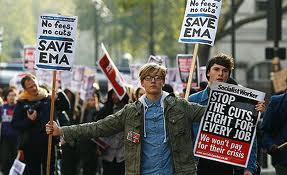
Last night on BBC Newsnight, Harriet Harman MP claimed that the cutting of Educational Maintenance Allowance had contributed to the recent appalling riots. Further to this, James Mills (the Labour researcher behind the ‘Save the EMA’ campaign) today tweeted his agreement with Harman that EMA was a factor behind the social unrest on our streets.
In this excellent article, guest blogger @JoshPugs explains in detail and first hand why Harriet Harman and the Left are so wrong.

'EMA was inefficient, wasteful and essentially corrupt'

During the autumn and winter of 2010 we witnessed the clamorous outcry of thousands of students who were furious with the Coalition Government’s education policies. Angry and bespotted quasi-academic youths filled our streets and television screens with ever-so-trendy Arabic neck scarves and defiant placards. Ostensibly, they demanded a Government U-Turn on the plans to raise tuition fees and to scrap Education Maintenance Allowance (EMA). However, when it comes to EMA, their protests were either based in ignorance, or mired the same greed with which they scornfully brand the Bankers.

In 2004, the Labour Government introduced the Education Maintenance Allowance. Officially, its purpose was to assist certain college students who come from lower income families with the day-to-day expenses associated with their further education. However, whilst removing barriers to education appears to be a worthy and noble objective, the reality is that EMA was an inefficient, wasteful and essentially corrupt system.
Under EMA, students who were eligible (their family income would have to be at least below £30,000) would be able to receive weekly awards of £10, £20, or £30 so long as they attended college. Additionally, if their attendance was high enough, they would qualify for termly £100 bonuses. The logic is clear, with these payments students could afford to attend college, be incentivised to keep their attendance up, and be rewarded with cash for pursuing further education… So far so good!

'EMA was paid to students directly in cash to be spent exactly how the individual wished'

However , the problems with EMA were huge. Firstly it was poorly targeted. Students with divorced parents could qualify for cash awards despite the fact that the Mum or Dad who didn’t live with them might be on £30k + and be providing them with regular stipends anyway. Secondly, and of far greater significance, EMA was paid to students directly in cash to be spent exactly how the individual wished. Whilst some students most certainly spent their EMAs on those items which were necessary for education, a vast amount was undoubtedly spent in TopShop and Starbucks across the nation. Or as one student commenting on The Guardian website (of all places) wrote: “The local drug dealer did very well out of EMA”. Just as duck ponds and pay-per-view porn were inappropriate uses of taxpayers' money when it comes to MPs' expenses, surely pairs of Nike trainers, tickets to V Festival and bottles of Lambrini are an equally wasteful and equally corrupt use of state coffers?

'...students who have genuine need will be able to get more support through the Bursary scheme than through the rightfully scrapped EMA'

Generic Lefty Protest Scarf, 'Buy it now with EMA'.
I’m not saying that some students don’t need financial support for further education. I firmly believe some provision is absolutely necessary. But rather than huge state-led blanket hand-outs, we need a system of support which takes into account the real need and real requirement of individuals who are committed to improving their educational lot. Fortunately Michael Gove has established the ‘16 – 19 Bursary’ which provides this. Unlike the EMA, schools, colleges and training providers will be responsible for awarding individual bursaries to students. They will also decide when bursaries are paid, and will set conditions that students should meet to receive a bursary, for example, linked to behaviour or attendance. In fact, students who have genuine need will be able to get more support through the Bursary scheme than through the rightfully scrapped EMA.
Now, don’t get me wrong, I can understand where those angry and protesting students were coming from. If I were a 17 year old student from a left-wing family who’d seen my £30 weekend money get denied to them by those “…what are they Mum and Dad? Oh yeah.. Tory Bastards!!!” I’d probably be protesting too. But let’s not take the piss. Get a part-time job. Or even better, found your own multi-million pound company.

'...graduate 3 years later with a 2:2 in media studies expecting decent employment to fall into their hands like manna from state-heaven'

This approach worked for Richard Branson and it worked for ‘Lord’ Alan Sugar. Do we really think that these business moguls would emerge as entrepreneurs if they had grown up in the benefit-centric hand-out culture of today? Is it in-fact more likely that they would be massaged into college, given their £30 a week (and their £100 bonus for actually turning up) and then ushered into University to graduate 3 years later with a 2:2 in media studies expecting decent employment to fall into their hands like manna from state-heaven?
No, far better for college students to get a part-time job (I was an Argos Monkey at the weekends) and learn the value of money. Let them gain some real work experience and some talking points on their CVs. Let them, like many others their age, learn that one must put something into society to get something out. And then yes, if they want to spend their hard-earned cash on clothes, booze and drugs – then I say ‘Go crazy!’ ‘Go mental!’ ‘ENJOY!’ But don’t expect the state to fund all this, and don’t march through the street protesting for your ‘right’ to largely disposable cash.
Last night on BBC Newsnight, Harriet Harman MP even claimed that the cutting of Educational Maintenance Allowance has contributed to the recent and appalling riots. Further to this, James Mills (the Labour researcher behind the ‘Save the EMA’ campaign) today tweeted his agreement with Harman that EMA was a factor behind the social unrest on our streets. And Harman and Mills will not be alone among the Left to voice such claims. And here, the Left might just have a point… After all, if you were a local drug dealer who’d seen your business with local Sixth Form smoking-area dry up, you’d probably have enough beef with Gove and Big Dave to smash a few shops up. But to suggest the scrapping of EMA led these young people to those awful deeds is simply absurd.
Let’s see EMA for what it was: an expensive Labourite bribe to gain young people’s votes. Now without it, the 16 – 19 Bursary is far better placed to provide for those who are truly in need.

Click now to follow @JoshPugs on Twitter

Click now to follow DPRUK.blogspot.com on Twitter

Related articles you may enjoy:


Tuesday, 9 August 2011

Chavriots of Fire


'...root of all that is unholy in the capital these past days'


The riots have nothing to do with poverty, disaffection or budget cuts. Labour's bastard children have only got state-paternalism and multicultralism to blame. Oh, and themselves of course...

With much of London still burning and the Twittersphere still spinning after days of rioting and looting, the blame game has already begun. 'Community workers' are blaming the ConservaLibs' plans to reduce the deficit, claiming that this is reducing the effectiveness of the police at the same time as the cuts are increasing the disaffection of those from disadvantaged areas. The Conservatives seem quiet on the issue of blame, a silence born from a lack of either confidence or certainty. One thing is certain, nobody in authority is publicly blaming themselves, but they are all at least partly responsible. The Met Police and the Home Office are spouting the usual 'this has nothing to do with race' and 'we are talking to community leaders to resolve issues'. However, the elephant in the room is being ignored; that the majority of rioting and looting is taking place in parts of the capital which are also the most ethnically diverse. Let me make one thing clear, this blog makes no comment on any particular race or ethnicity, positive or negative. It does however, pursue the point that the multiculturalism experiment (as an 'ism') which was created by the liberal left and promulgated by both ends of the spectrum is at the root of all that is unholy in the capital these past days.


'State being too terrified of the liberal left's equality/human rights lobbies to actually seize the initiative and stamp out disorder'


ATM does not charge for withdrawals
What we are now witnessing is the hard-edged result of decades of soft-touch multicultural dreaming. The last 15 years have witnessed massive 'investment' in thousands of community outreach workers and Police Community Support Officers (PCSOs) as well as many more spurious 'created' jobs in order to prevent a repeat of Brixton '81. However, despite this, indeed likely because of it, a severe over-sensitivity towards race relations gripped and then paralised successive Labour governments into inactivity. Both Blair and Brown's administrations completely failed to resolve any of the underlying socio-economic issues which have eventually and ultimately brought London to the brink. State-sponsored jobsworthyism has resulted in the organs of State being too terrified of the liberal left's equality/human rights lobbies to actually seize the initiative and stamp out disorder in racially sensitive areas. Rather, a policy of patronising the 'yoof' through the medium of CV writing skills classes and youth clubs has been the defining character of the government's approach over the last decade and a half. However, the deep routed social breakdown at the heart of the rioting will not be resolved by community outreach workers talking to community leaders in an attempt to stabilise the situation.  Outreach workers can't make arrests, community leaders aren't burning shops. The Conservalib government have inherited a socio-economic model which is fundamentally flawed. David Cameron must adapt policy in order to give social cohesion a chance. If ever a big society rather than a big state were needed, the time is now.


Survived the Blitz, destroyed by multiculturalism
Labour have managed to convince us all that multiculturalism is a positive thing, that to criticise the theory is an act of racism. This is not true of course, criticism of one 'ism' does not make one into an 'ist', the concept of multiculturalism is an entirely subjective and politicised theory which suggests that people of all cultures can live side-by-side in harmony. Conversely, the facts are such that North London plays host to vast social ghettos of people from all over the world who insulate themselves from British values. The ridiculous racial over-sensitivity which has been at the forefront of the Met's policing philosophy since Brixton '81 and the Stephen Lawrence inquest has brought the country to a position where the youth in these areas see no authority in the police or the rule of law. They are now behaving accordingly; lawlessly. 


Time and again we have heard these last few days 'I can't believe that this is happening in Britain'. It's not, it's happening in areas of the country where Britishness is absent.


'...time we stopped draining our GDP away paying for spurious public servants who do unaccountable, intangible and ineffectual work'


The solution lay in not being afraid of stating and dealing in truth. It is a shame that local Labour MPs David Lammy and Diane Abbot spent 13 years denying the reality on the ground, when they could have spent that time (and money) actually dealing with the socio-economic dissaffection which is at the root of all this. Germany's Angela Merkel has publicly stated that multiculturalism has 'utterly failed', so should we for admitting that there is a problem is always the first step towards finding a cure. For now, May and Cameron have to restore order and confidence to the streets by means of a show of force. Reinforcing the Police with troops ring-fenced for civil emergency in  Northern Ireland and who are trained for just such lawlessness on home soil would be a good place to start. In the long term, it's time we stopped draining our GDP away paying for spurious public servants who do unaccountable, intangible and ineffectual 'work' in these areas and use that money for more police officers. 
Lawlessness can only be annulled by the firm rule of law. This applies in the long-term as much as it does in the short-term. 
In short, a few less of carrots, a bit more stick. Permanently.


Click to follow me on Twitter: @HortonEddison


Tuesday, 19 July 2011

Johnnie 'Marbles' May-Bowles


The man who attempted, but entirely failed, to defeat a tag-team comprised of an octogenarian media mogul and his 6stone Chinese wife has been named as Johnnie May-Bowles.


Nice shirt 
May-Bowles, dressed in the uniform of the 'oh so working class' movement UKuncut (mid 30's comb-over and a 1990s lumberjack shirt) attempted to attack Rupert Murdoch during his appearance at the Culture, Media and Sport select committee. May-Bowles brands himself as 'Johnnie Marbles' in a pathetic attempt at ridding himself of the upper-middle class yoke of his privileged upbringing and University education at Royal Holloway. A typical member of the champagne-socialist group 'UK Uncut', May-Bowles has successfully managed to accomplish several things:


1.) Dilute the pressure on the very person he wished to attack
2.) Completely expose the contradiction within himself and within the organisation of which he is a part  
3.) Make a family name of Wendi Murdoch


Johnnie May-Bowles is a wannabe stand-up comedian. It may be that this has been a profile raising publicity stunt for his own means. However, it is difficult to imagine that any newspaper in the happy NewsCorp family is likely to print anything complimentary about him. In fact,  this has been yet another of UK Uncut's failed publicity events, almost on a par with fellow self-loathing middle-classer Charlie Gilmour's defamation of the Cenotaph. Therefore, I suggest that rather than accept UK Uncut as part of the fabric of modern society, we should treat them with the same kind of contempt in which they have held parliament and our nation's war dead.


UK Uncut have no cause or indeed even a basic grasp of economics or the rule of law. They are comprised of a group of pseudo-intellectual champagne socialist 'wannabes'. Time to hang up the humus guys.

Follow me on Twitter: @HortonEddison


Saturday, 16 July 2011

Why we cut our defence budget & increase aid spending


Every week on television, in the newspapers or online we see or hear about DFID (the Department for International Development) spending money on aid abroad, while we face public spending cuts at home. Indeed, the last Labour government gave £800million a year in aid to China, and the current government gives millions each year to India despite both economies being larger and faster growing than our own. This week the UK development secretary Andrew Mitchell committed the UK tax payer to a further £53million in order to help ease the effects of drought in East Africa. In-fact, despite the Coalition government's controversial current and planned spending cuts across all other departments, DFID's budget has been 'ring fenced'. However, having trawled DFID's website, I can find no justification for their existence or indeed for this amount of public expenditure. So, what's going on? Surprisingly, the answer is essentially '9/11'.


Future friend or foe?
As ever, the policy in practice is founded in a seemingly abstract academic political theory, in this case from the arena of Critical Security Studies (CSS). Without going into laborious detail, the idea is that it is 'emancipation, not power or order which produces true security', which translates as the idea that true security is achieved only when the individual is able to live a life free from threat.


Among the populations of the West, such threats are commonly perceived as foreign military attack or more recently, the actions of those engaged in terrorism. Against this backdrop, CSS argues that most wars or terrorist actions  are undertaken in order to improve the living conditions and political aims of those who live in societies where the threat to individual security is more likely to be famine, thirst, rape or genocide as it is to be war or terrorism. Quite simply, emancipation from exposure to these threats is the type of security that those in the developing world are willing to fight and die for.


In the developed and the developing world, all countries have traditionally spent vast treasures on the formation and maintenance of conventional armed forces i.e. land, naval and air power, in order to protect against threats posed by those states or non-state actors who are willing to fight and kill us. Surely then, in the field of international conflict and security, prevention would be better than cure? 


Indeed, CSS argues that money spent on the emancipation of individuals from such threat motivations (hunger, disease etc) in the developing world also keeps us safe here in the West. i.e. our own national security is linked to the individual securities of those who might become our enemies. 


Essentially, sharing our resources with those who are dying from socio-economic threats will bring about emancipation from such threats, and will also
prevent the kind of anger which has expressed itself through terrorism against the West in growing regularity since the 1980's. Imagine for a moment an Afghanistan of the 1990s which was emancipation from the threat of hunger, violence and lack of education. It is difficult to imagine that such a country would have ever become the breeding ground for terrorism as indeed it became in the period before 9/11.


Te government is slashing defence spending and increasing the budget for DFID. It is hoped that by spending less on traditional armed forces, like tanks, aircraft carriers and battalions infantry, and more on International Development, the UK is ensuring the emancipation of those who might become our enemies from the reasons that they would want to do so. It is hoped that in the long run, prevention will be cheaper than cure.   


Follow me on Twitter here: @HortonEddison